 Available in US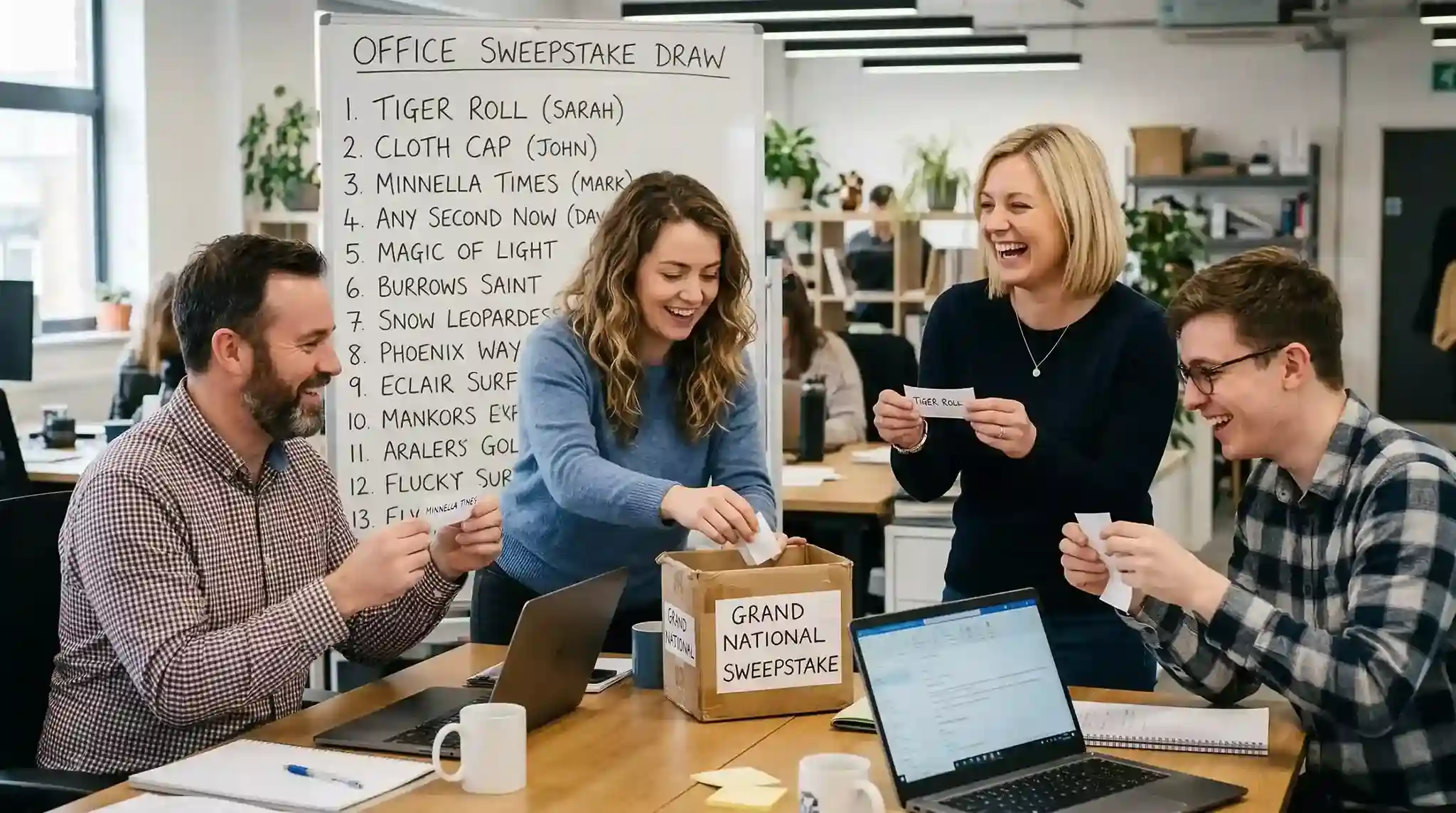
The Grand National sweepstake is one of those peculiarly British traditions that survives entirely on goodwill, spare change, and the collective willingness of office workers to pretend they care about a horse they drew from a hat five minutes ago. It is also the most accessible form of Grand National participation: no betting account needed, no form-book knowledge required, no agonising over odds or each-way terms. You pay your entry fee, draw a horse at random, and spend the next few hours either cheering wildly or watching your horse refuse at the first fence.
According to an OLBG survey, around 17% of UK adults planned to bet on the Grand National in 2025, and a significant proportion of that participation comes through workplace and social sweepstakes rather than formal bookmaker bets. With roughly 30% of Grand National bettors being first-timers or returning after a long break, the sweepstake is often the gateway — the way everyone’s in the race without anyone needing to understand what 14/1 each-way at one-quarter odds actually means.
Grand National Sweepstake — More on this topic at grand national betting odds.
Sweepstake Rules: The Standard Format
The standard office sweepstake works as follows. Each participant pays a fixed entry fee — £2 is the most common, though some offices go higher. The organiser writes the names of all declared Grand National runners on individual slips of paper, folds them, and drops them into a container. Participants draw slips at random. Each person gets one horse. The prize pot — the total of all entry fees — is then divided among the holders of the first, second, and third-placed horses, with a typical split of 60% to first, 25% to second, and 15% to third.
Variations abound. Some sweepstakes pay four places to match standard each-way terms. Others include a consolation prize for the last-place finisher or the first horse to fall — a nod to the Grand National’s chaos and a way of keeping everyone engaged until the end. The organiser sets the rules before the draw, and consistency matters: changing the prize structure after people have drawn their horses is a fast route to workplace discord.
With 34 runners in the 2026 Grand National and most offices having more than 34 willing participants, the organiser faces a logistical question. One solution is to hold multiple draws: once the first 34 slips are allocated, the remaining participants draw from a fresh set. A simpler alternative is to limit entry to 34 people or to allow shared horses — two or three people splitting a single horse and sharing any winnings proportionally. The purist approach is one horse per person, maximum 34 entries, with late arrivals missing out. It concentrates the prize pot and sharpens the competitive edge.
If fewer than 34 people enter, some horses go undrawn. This is fine — the unclaimed horses simply run without anyone cheering for them. It does, however, reduce the prize pot, which is why larger offices sometimes raise the entry fee to compensate. A 20-person sweepstake at £5 each produces the same £100 pot as a 50-person draw at £2, but with more meaningful individual payouts.
Handling Non-Runners and Late Withdrawals
Non-runners are the bane of sweepstake organisers. A horse might be declared to run at the five-day stage, get drawn in the sweepstake on Thursday, and then be withdrawn on Saturday morning due to the going, a late setback, or trainer discretion. The person holding that horse now has a dead slip and no runner.
The cleanest solution is to conduct the draw as late as possible — ideally after the final declarations on the morning of the race, when the confirmed field is known. This eliminates the non-runner problem entirely but requires the draw to happen on Grand National Saturday, which may not suit every workplace. If the draw must happen earlier in the week, the organiser should set a clear non-runner policy in advance. The two most common options are a redraw, where the non-runner slip is replaced by a reserve horse drawn at random by the affected participant, or a refund, where the participant receives their entry fee back and the prize pot is reduced accordingly.
A third option, increasingly popular, is to include reserve horses in the initial draw. The organiser lists all entered horses, not just those confirmed to run. If a drawn horse is subsequently withdrawn, the participant keeps their entry fee in the pot and is simply out of luck — the same as drawing a slow horse or one that falls at the first. This approach is harsh but fair: it mirrors the randomness that makes sweepstakes enjoyable in the first place and avoids the administrative headache of late redraws.
Digital Sweepstake Tools
The paper-slip-in-a-hat method is a classic, but it scales poorly across hybrid and remote workplaces. Several free online tools now automate the Grand National sweepstake process. These platforms let the organiser enter the list of declared runners, invite participants via email or a shared link, collect entry fees digitally through a payment app, and run the random draw with a single click. The results are distributed instantly, and the non-runner issue can be built into the rules at setup.
For larger organisations or social groups, a dedicated sweepstake spreadsheet works well. A simple shared document listing every runner, the person who drew each one, and the prize structure is transparent and prevents disputes. The draw itself can be randomised using a basic number generator — no need for physical slips. The key is that the randomisation process is visible and trusted. If the organiser draws the Grand National favourite, suspicions will follow unless the draw was conducted in the open or through a verifiable digital method.
Printable sweepstake kits — PDF templates with horse names, draw grids, and rules summaries — remain popular for offices that prefer the tactile experience. Several horse racing and betting information sites publish updated kits each year once the final field is confirmed. These kits typically include a results tracker so participants can follow the race and record finishing positions as they happen, adding a layer of shared engagement that a purely digital draw misses.
Key Takeaway
A well-run Grand National sweepstake is the simplest way to get a group of people invested in a race that most of them would otherwise watch passively or ignore entirely. Set the rules before the draw, decide how to handle non-runners in advance, use a trusted randomisation method, and keep the entry fee low enough that nobody feels the sting of drawing a 100/1 outsider. The Grand National has always been a shared national event — a sweepstake is just the smallest, most personal version of that experience, played out in kitchens, offices, and group chats across the country.
See also Grand National Betting for Women.
