
 Available in US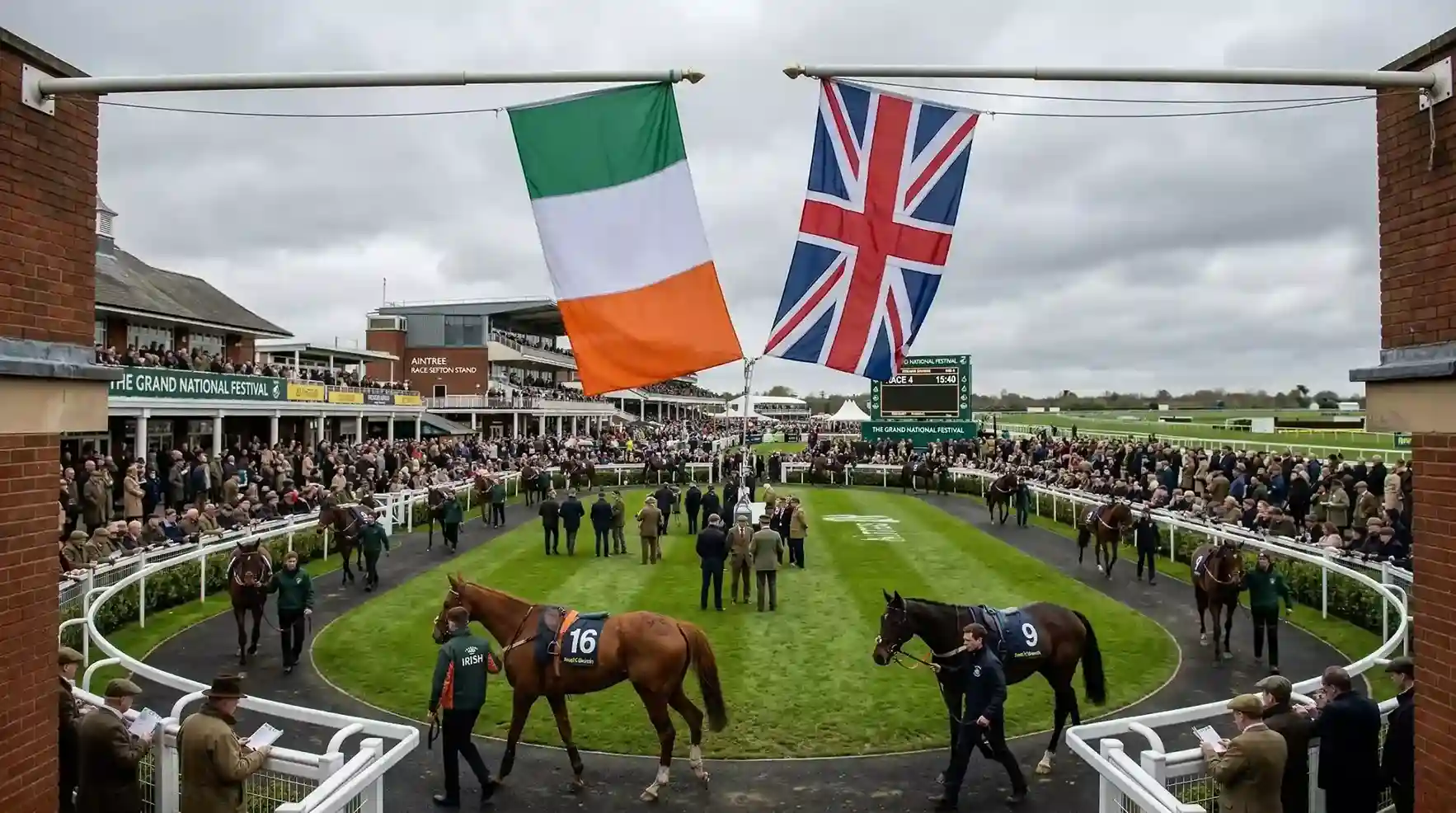
The Grand National has always attracted runners from both sides of the Irish Sea, but the balance between them has shifted dramatically in the last decade. Of the 78 entries for the 2026 Grand National, only 29 came from British-based trainers. The remaining 49 — nearly two-thirds of the entry list — were trained in Ireland. That ratio is not an anomaly. It is the culmination of a structural shift in National Hunt racing that has reshaped the Grand National’s competitive landscape and, with it, the betting market. This is the green tide, and the data says it is still rising.
For bettors, the dominance of Irish trainers is not merely a cultural observation. It has practical implications for selection, for form analysis, and for how you interpret the ante-post market. A Grand National field that is 60% or more Irish-trained is a fundamentally different proposition from one that was evenly split, and the approach to betting on it should reflect that reality.
Irish vs British Trainers at the Grand National — More on this topic at grand national betting odds.
Entry and Win Rates: Ireland vs Britain
The numbers tell a clear story. In 2015, Grand National entries totalled 126, and British trainers contributed a substantial majority. By 2026, entries had dropped to 78, and the balance had inverted — Irish trainers now dominate both the entry list and the final field. The decline in British entries is steeper than the overall decline: it is not just that fewer horses are entered in total, but that British yards are withdrawing from the race at a faster rate than their Irish counterparts.
Win rates amplify the pattern. The last decade of Grand National results has been dominated by Irish-trained runners. Tiger Roll (Gordon Elliott, 2018 and 2019), I Am Maximus (Willie Mullins, 2024), Minella Times (Henry de Bromhead, 2021), and Noble Yeats (Emmet Mullins, 2022) all crossed the Irish Sea to win at Aintree. British-trained winners in the same period — One For Arthur (Lucinda Russell, 2017) and Many Clouds (Oliver Sherwood, 2015) — are the exceptions rather than the rule.
The trend is not limited to winning. Irish-trained horses occupy a disproportionate share of the placed positions too. In several recent Grand Nationals, the first three or four home have all been Irish-trained. The depth of the Irish challenge means that even when one Irish runner disappoints, two or three others fill the void. British trainers sending one or two hopeful entries into a field containing a dozen battle-hardened Irish chasers are fighting a numbers game that is increasingly difficult to win.
Why Irish Yards Dominate the Staying Chase Division
The reasons for Irish dominance are structural, not accidental. Ireland’s National Hunt racing programme is built around staying chases and long-distance hurdle races to a greater extent than Britain’s. Irish point-to-point racing — the grassroots level where young horses learn to jump — produces a conveyor belt of athletic, scopey chasers who are bred and educated for exactly the kind of test the Grand National presents. British National Hunt racing, while still competitive at the top level, has a smaller breeding and education pipeline.
The concentration of resources matters too. Willie Mullins and Gordon Elliott between them have hundreds of horses in training, with dedicated staff, state-of-the-art facilities, and the financial backing of major ownership groups. Their operations are scaled to campaign multiple Grand National entries simultaneously — assessing each horse’s suitability, targeting the optimal preparation races, and making late tactical decisions about which runners to commit and which to withdraw. No single British training operation matches that scale in the staying chase division.
Prize money disparity plays a role as well. Irish trainers have strong financial incentives to target British races, where the purses are significantly higher than in Ireland for equivalent contests. The Grand National’s £1 million prize fund is unmatched in either jurisdiction, and for an Irish yard with several potential candidates, the cost of travelling to Aintree is trivially small compared with the potential reward. British trainers, who do not face the same travel costs, might be expected to have a home advantage — but the quality gap in horse material has eroded that advantage almost entirely.
Paul Nicholls, one of Britain’s most successful National Hunt trainers and a Grand National winner with Neptune Collonges in 2012, did not enter a single runner in the 2026 Grand National. He has been open about the shifting landscape, expressing no surprise at the declining entry numbers and the growing difficulty of competing with Irish-trained horses at the staying chase distances the National demands. When a trainer of Nicholls’s calibre steps back from the race, it signals a structural issue rather than a temporary fluctuation.
What It Means for Bettors
The practical implication is straightforward: any serious Grand National selection process must weight Irish-trained runners heavily. The ante-post market already reflects this to some degree — Mullins and Elliott runners are routinely among the shortest-priced horses — but the casual betting public still gravitates toward familiar British names, creating potential value on lesser-known Irish entries that the form book supports.
When assessing Irish runners, pay particular attention to the trainer’s Aintree record, the horse’s experience over demanding fences (including Irish equivalents like Punchestown and Fairyhouse), and whether the horse has been specifically targeted at the Grand National rather than entered as a speculative afterthought. An Irish trainer who has confirmed a horse at every declaration stage and provided a positive public assessment of its chance is a different proposition from one who has entered six horses and will withdraw four at the confirmation stage.
The data also suggests that blindly opposing all British-trained runners is an overcorrection. British winners do still emerge, and the occasional British contender that truly fits the Grand National profile — lightly weighted, course-experienced, well-prepared — can represent exceptional value precisely because the market has overcorrected toward the Irish challenge. The key is to assess each horse on its individual merits while acknowledging that the structural advantage currently sits firmly on the Irish side.
Key Takeaway
Irish trainers now dominate the Grand National entry list, the final field, and the recent results. The green tide is driven by structural factors — breeding, scale of operations, and financial incentives — that are unlikely to reverse in the near term. For bettors, this means Irish-trained runners should form the core of any Grand National shortlist, with particular attention to the Mullins and Elliott operations. British-trained contenders are not to be dismissed, but they are now the exception in a race that has become an increasingly Irish affair. The data does not lie, and the data says to follow the horses that cross the Irish Sea.
See also Grand National Entries Trend.
