
Best Horse Racing Betting Sites – Bet on Horse Racing in 2026
Loading...
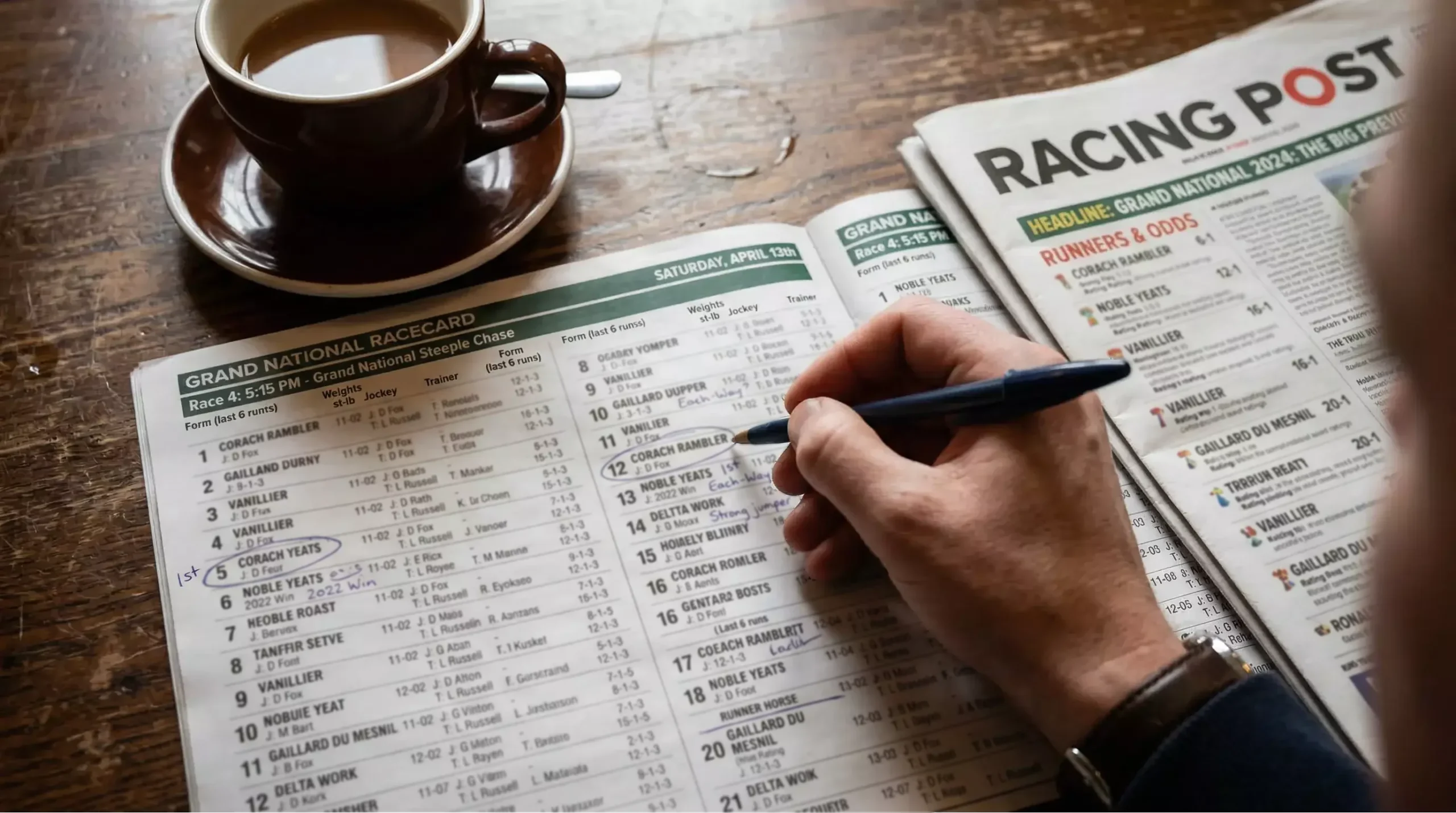
The Grand National is one race with thirty-four runners and, depending on when you look, dozens of different prices for every single one of them. A horse quoted at 14/1 with one bookmaker might be 16/1 somewhere else and 12/1 at a third — and none of those firms has made an error. They have simply assessed risk, balanced their books, and landed on different numbers. For a once-a-year punt that is perfectly normal. For anyone serious about extracting value, it is a problem worth solving.
Grand National odds comparison is not about chasing fractions of a point on a short-priced favourite. It matters most when every point of odds genuinely changes what comes back if your horse finds a way over thirty fences and up that long Aintree run-in. The remote betting market for horse racing generated £766.7 million in gross gaming yield in 2024–25, according to the Gambling Commission. A chunk of that revenue exists precisely because many punters never shop around for odds. This guide is about making sure you are not one of them.
Why Odds Differ Between Bookmakers
Every bookmaker prices up the Grand National from roughly the same raw material — form ratings, handicap weights, trainer records, going forecasts — but the way each firm turns that information into a price is not standardised. A large operator with heavy liabilities on a popular horse will shorten its odds to discourage further money. A smaller book looking to attract volume might keep that same horse a couple of points longer. Neither price is wrong. They reflect different commercial positions.
Three factors drive the gap most consistently. First, the over-round. This is the built-in margin that guarantees a bookmaker profit if bets are spread evenly. In a 34-runner Grand National, over-rounds vary noticeably between firms. A book with a 140% over-round is extracting far more margin than one running at 120%, and that difference shows up in the prices. The tighter the book, the better the odds available to you.
Second, liability management. Once a firm takes a large ante-post bet on a particular horse — say, £5,000 on a 25/1 shot weeks before the race — it may cut that horse’s price to limit further exposure while pushing others out. A rival who has not taken that same liability has no reason to move. This is why price discrepancies widen significantly in the ante-post period, sometimes by five or six points on midfield runners that the general public is not watching closely.
Third, promotional strategy. Some operators deliberately offer best price on high-profile races like the National to attract new customers. They accept a thinner margin on one event to build an account base they can monetise across the rest of the year. These promotional prices are genuine, but they tend to appear on favourites and popular selections rather than across the entire card.
The combined effect is a market where the same horse at the same moment can legitimately be priced anywhere within a three-to-five point range. On a £10 each-way bet at 25/1, the difference between 25/1 and 28/1 is an extra £30 in pure win profit before you even consider the place part. That is not a rounding error — it is the cost of not checking.
How to Compare Grand National Prices Efficiently
The simplest method is an odds comparison site. Services like Oddschecker aggregate prices from licensed UK bookmakers in real time, showing you the best available price for each runner in a grid format. For the Grand National, these grids update constantly once ante-post markets open and become especially volatile in the final 48 hours before the race. The grid does the scanning for you — all you need to do is have accounts with enough firms to act on the best price when you see it.
Having accounts with multiple bookmakers is the unglamorous reality behind effective comparison. Two or three accounts is a starting point; five or six gives you meaningful coverage of the market. This is not about chasing welcome offers — it is about structural access to different prices. When one firm has your selection at 20/1 and another at 25/1, the only thing preventing you from taking the better price is not having an account with the right operator.
Timing matters as much as price. Ante-post markets for the Grand National open months in advance, but liquidity is thin and prices are wide. As declarations narrow the field, the market tightens. The sharpest price differences tend to appear in two windows: immediately after Cheltenham Festival results reshuffle the market, and again in the 24 hours before the off, when late money pours in. Roughly 32% of online bets on the Grand National are placed in the minutes before the start, according to data from horseracing.guide — a surge that compresses spreads but also creates short-lived value for those watching closely.
One practical consideration: check whether the bookmaker offers Best Odds Guaranteed on the National. With BOG, if you take a price on the morning of the race and the starting price drifts higher, you receive the better price automatically. This effectively gives you a free option — you lock in a price with no downside if the market moves in your favour. Not all firms extend BOG to ante-post bets or to the National specifically, so verify the terms before assuming you are covered.
Finally, do not overlook the exchange option. Betting exchanges like Betfair let you back at odds determined by other punters, not by a bookmaker’s margin. Exchange prices on Grand National runners are often a point or two longer than the best fixed-odds price, though liquidity on outsiders can be thin until race week. For horses in the 10/1 to 25/1 range — the zone where most serious comparison happens — exchanges frequently offer the outright best price.
What Market Movers Tell You on Race Day
A market mover is any horse whose odds shorten noticeably across multiple bookmakers in a short space of time. In flat racing, where fields are smaller and information channels are well-known, a sustained move from 10/1 to 6/1 might signal genuine insider confidence. In the Grand National, the picture is messier. The sheer volume of casual money — the race attracts around £250 million in total wagers, much of it from once-a-year punters — means that large amounts can land on a horse for no analytical reason at all. A horse might shorten because it has an appealing name, because a newspaper tipster put it up, or because someone on social media posted a confident-sounding thread.
That does not mean all moves are noise. There are patterns worth watching. If a horse shortens first on exchanges and then across fixed-odds books, the money is more likely to be informed. Exchange bettors tend to be more sophisticated; when they move a price, bookmakers notice and adjust. Conversely, if a horse shortens only at one or two retail firms while staying the same on exchange, the move is probably driven by lopsided retail liability rather than new information.
Weather-driven moves are the exception to the noise problem. If the going at Aintree shifts from Good to Soft on Friday evening, horses with strong soft-ground form will shorten on genuine merit. These moves tend to be sharp and sustained rather than gradual. Earth Summit, winner in 1998 at 7/1, was a classic weather-driven mover — his odds contracted dramatically once heavy rain hit Liverpool that week. Identifying the cause of the move is as important as spotting the move itself.
For the odds-comparison bettor, market movers serve a secondary purpose: they disrupt the price grid. When bookmakers scramble to adjust prices on a fast-shortening horse, they sometimes overshoot on others, pushing drifters to prices wider than they should be. If your pre-race analysis has identified a horse at fair value of 20/1, and it suddenly appears at 25/1 because the bookmaker has shortened a rival aggressively, that is a comparison opportunity worth acting on.
Key Takeaway
Odds comparison on the Grand National is not a marginal exercise — it is where the easiest gains in this market live. The differences between bookmakers are real, persistent, and large enough on a 34-runner handicap to materially change your return. Open accounts with several licensed operators, use a comparison grid, check for Best Odds Guaranteed, and pay attention to the exchange price before committing. Time your final comparison in the hours before the off when the market is deepest. None of this requires special knowledge or analytical skill. It requires only the discipline to look at more than one number before you put your money down.