
 Available in US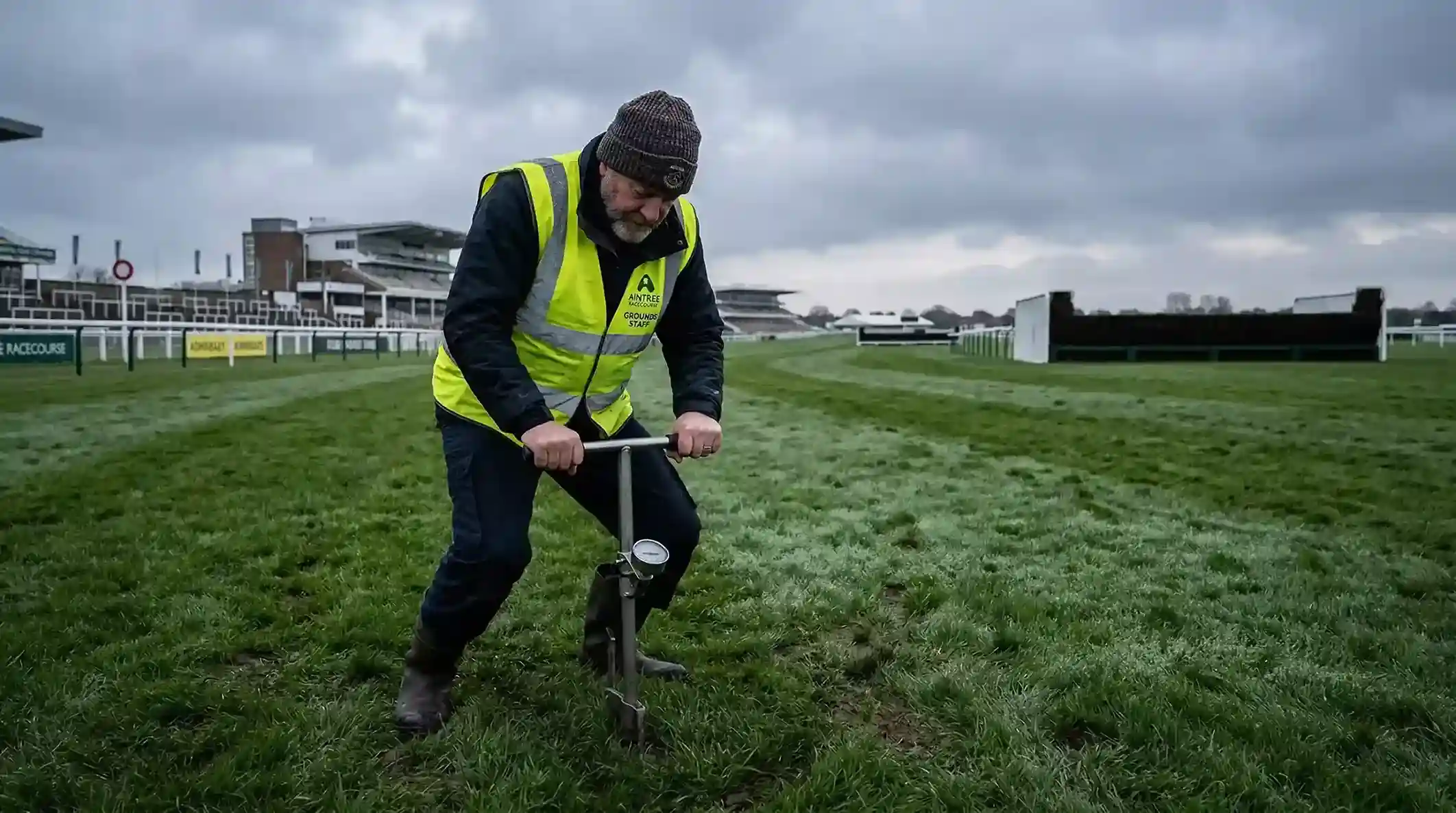
The going — the official description of ground conditions at Aintree — is the single most underrated variable in Grand National betting. Most casual punters focus on form, trainer reputation, and the horse’s name without ever checking whether the ground will suit their selection. Yet a horse that excels on Good ground may be a completely different proposition on Soft, and the difference can mean several points of odds movement in the hours before the race. The ground beneath their hooves shapes every stride of the four-mile journey, and for the 34 runners lining up in 2026, it will separate the horses that handle conditions from those that merely endure them.
Aintree in April is exposed to the full range of British spring weather. The going can be anything from Good to Firm (rare but possible after a dry spell) through Good, Good to Soft, Soft, and Heavy. Each condition changes the race’s character — the pace, the energy demands, the type of horse that thrives. Understanding the going, and knowing how to use it in your betting, is one of the simplest analytical edges available.
Grand National Going Conditions and Odds Impact — More on this topic at grand national betting odds.
Going Descriptions: Good, Soft, Heavy
The BHA’s going system uses standardised descriptions that reflect the moisture content and firmness of the racing surface. Good ground is the baseline: turf that is neither waterlogged nor dried out, offering a firm but resilient surface that suits the widest range of horses. Good to Soft is the most common Aintree going for Grand National day — slightly cushioned, with enough give to protect legs without seriously slowing the pace.
Soft ground is where the going begins to have a decisive influence. On Soft, each stride demands more energy as hooves sink into yielding turf. Horses that do not handle give in the ground tire dramatically over the Grand National’s extreme distance. A horse that is competitive at three miles on Soft may find the extra mile at Aintree impossible when the ground is against it. Heavy ground amplifies this effect further — it turns the Grand National into a war of attrition where stamina and willingness matter more than speed or jumping technique.
At the other extreme, Good to Firm ground — which occurs when Aintree has a dry spring — produces faster times and a different type of race. Quick ground favours speedier types and reduces the stamina advantage that heavy ground creates. It also increases the jarring impact of landing over fences, which can be a concern for horses with leg issues. Grand Nationals on quick ground tend to be more competitive across the speed range but can produce unexpected fallers at fences where the firm landing catches horses off guard.
The going is officially assessed by the clerk of the course, who uses a penetrometer — a device that measures the resistance of the ground surface — along with visual inspection and weather forecasting. The going report is updated regularly in the days before the race and can change significantly between Thursday morning and Saturday afternoon depending on rainfall.
How Going Affects Form and Odds
The connection between going and odds movement is direct and measurable. When the going at Aintree shifts from Good to Soft on Friday evening — which happens with some regularity in April — horses with proven soft-ground form shorten immediately. A horse that was 20/1 on Thursday might be 14/1 by Saturday morning purely because the ground conditions have moved in its favour. Conversely, a horse whose form is exclusively on Good ground will drift several points as the market prices in its reduced chance on a yielding surface.
The effect is most pronounced in the middle of the market. Favourites tend to be versatile enough to handle a range of conditions — that versatility is part of what makes them favourites. But horses in the 14/1 to 33/1 range often have clearer ground preferences, and a shift in the going can promote a 25/1 shot to a 16/1 contender or relegate a 14/1 fancy to 20/1 drifter. These are the movements that create race-day value for bettors who have done their homework on going preferences.
The historical record confirms the going’s importance. Earth Summit won the 1998 Grand National at 7/1 after heavy rain turned Aintree into a mud bath — his price had been significantly longer before the weather intervened. Many Clouds, the 2015 winner at 25/1, was a horse that relished soft ground and whose Aintree prospects improved markedly when the going eased. In both cases, the going change was the catalyst that turned a contender into a winner.
Grand National entries have declined from 126 to 78 over the last decade, partly because trainers are more selective about running horses on unsuitable ground. The reduced field of 34 means that the horses that do line up are more likely to have some degree of ground versatility — trainers are less willing to waste a Grand National entry on a horse that can only perform on one specific surface. This makes the going slightly less of a differentiator than it was in the era of 40-runner fields full of speculative entries, but it remains a critical factor for separating live contenders from also-rans.
Historical Going at Aintree and Its Impact
Aintree’s location near Liverpool makes it susceptible to Irish Sea weather systems that can deliver significant rainfall at short notice. The most common going description for Grand National day over the last two decades has been Good to Soft — a surface that favours staying power without eliminating faster-ground horses entirely. Good to Soft is the neutral setting for the Grand National: it does not dramatically favour one type of horse, which is part of why it produces competitive and often unpredictable results.
Soft or Heavy going has occurred on several occasions, and these renewals tend to produce longer-priced winners. The extreme ground eliminates a larger portion of the field — horses pulling up, tiring, or making jumping errors they would not make on better ground — which increases the randomness of the outcome. For bettors, a Soft or Heavy Grand National is a race where longshots carry more value than usual, because the ground itself acts as an equaliser that negates the class advantages of better-rated horses.
Good or Good to Firm going is the rarest condition for the Grand National and tends to produce results that align more closely with the market. Faster ground rewards the better horses, reduces the attrition rate, and compresses the finishing order. The 2024 running on Good to Soft ground saw I Am Maximus — one of the best-fancied runners — win with relative authority, consistent with the expectation that decent ground favours form.
Key Takeaway
Going conditions are a hard filter in Grand National selection, not a soft preference. Check the going forecast before you bet, cross-reference each horse’s form on the expected surface, and be prepared to adjust your selections if the ground changes between Friday evening and Saturday afternoon. Soft ground favours stamina specialists and increases the probability of longer-priced winners. Good ground favours the classier runners and produces more formful results. The ground beneath their hooves will be one of the most important factors in the 2026 Grand National — make sure it is a factor in your betting too.
