
 Available in US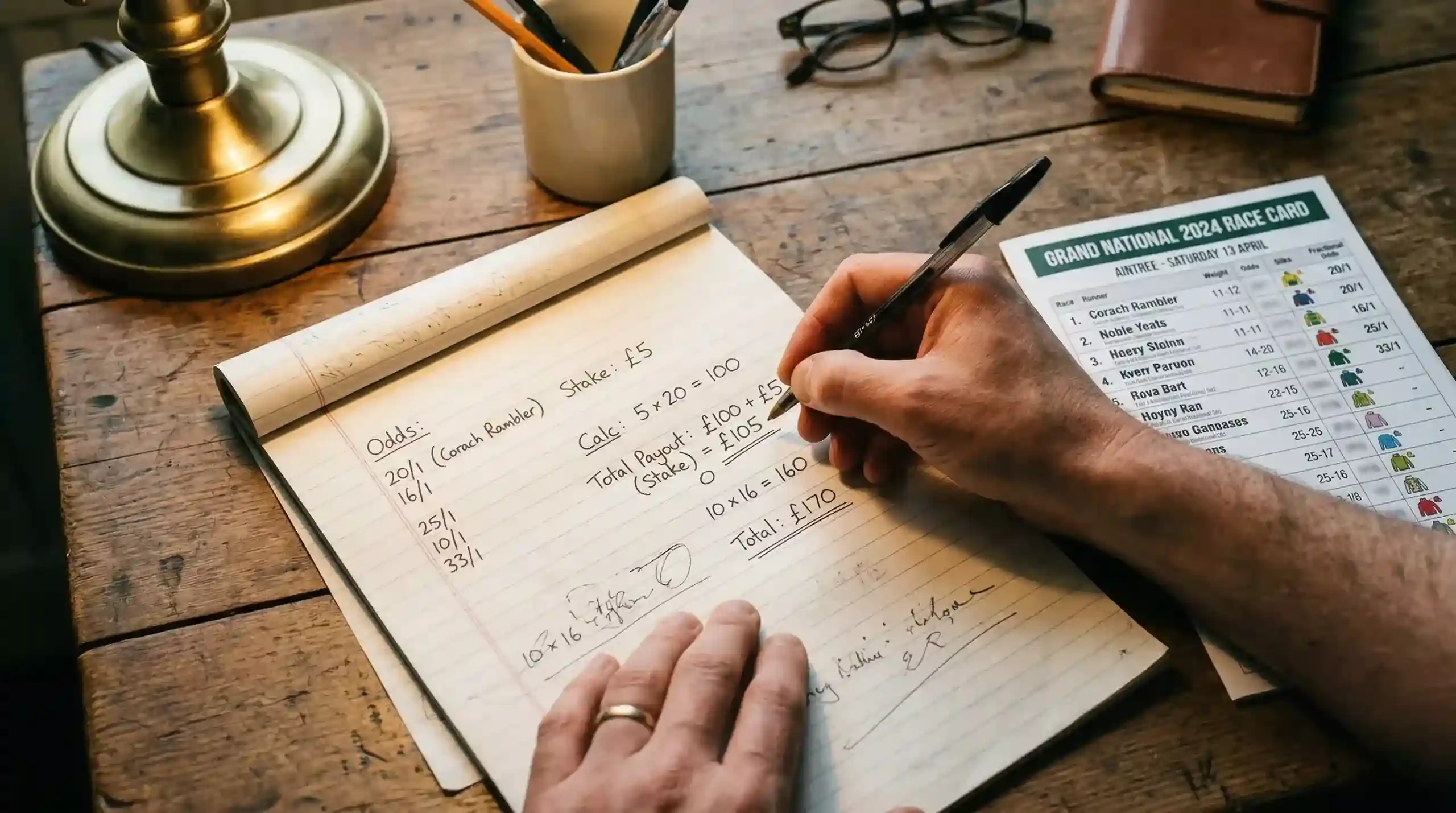
Every year, roughly £250 million is bet on the Grand National, and a remarkable proportion of that money is placed by people who are not entirely sure what they will receive if their horse wins. The odds are displayed — 14/1, 20/1, 33/1 — but the connection between those numbers and the actual cash that lands in your account is hazier than it should be. Each-way bets add another layer: a second calculation running alongside the first, with different odds, different conditions, and a result that depends on where your horse finishes, not just whether it wins.
This is a guide to the maths behind Grand National payouts. No jargon, no assumptions about what you already know — just the formulas, worked through with real examples at the kind of stakes that Entain data confirms most people actually bet: 82% of cash wagers on the race are £5 or less. The goal is simple: know your return before you bet.
Grand National Betting Odds Calculator — More on this topic at grand national betting odds.
Win Bet Calculation: Three Quick Examples
A win bet is the simplest wager in racing. You pick a horse, you stake your money, and if the horse finishes first, you win. The payout is determined by the odds at the time your bet is placed — or the starting price, if you take SP or have Best Odds Guaranteed.
The formula for fractional odds is: (stake x numerator / denominator) + stake = total return. The first part of the formula is your profit; adding the stake back gives you the total amount returned to your account.
Example one: a £5 win bet at 10/1. Profit = £5 x 10/1 = £50. Total return = £50 + £5 = £55. You hand over a fiver and get back fifty-five pounds. The original stake is always included in the return, which is worth remembering when comparing your balance before and after a winning bet.
Example two: a £5 win bet at 7/2. Profit = £5 x 7/2 = £17.50. Total return = £17.50 + £5 = £22.50. Fractional odds with a denominator other than 1 are where many people stumble. The trick is to treat the fraction as a simple division: 7 divided by 2 = 3.5, then multiply by your stake. £5 x 3.5 = £17.50 profit.
Example three: a £5 win bet at 33/1. Profit = £5 x 33 = £165. Total return = £165 + £5 = £170. At 33/1, a fiver becomes £170 — the kind of return that makes the Grand National such a compelling betting event for small-stakes punters. The average Grand National winner goes off at roughly 20/1, which on a £5 stake would return £105. That is the realistic baseline for what a successful Grand National bet looks like at the most common stake level.
Each-Way Calculation: Step by Step
An each-way bet is two bets in one: a win bet and a place bet, at equal stakes. A £5 each-way bet costs £10 in total — £5 on the win and £5 on the place. If the horse wins, both parts pay out. If the horse places (finishes in the top four under standard Grand National terms) but does not win, the win part loses and the place part pays out at a fraction of the win odds.
The standard place terms for the Grand National are one-quarter the odds for the first four places. Some bookmakers offer enhanced terms — five, six, or seven places — but the calculation method is identical; only the number of qualifying positions changes.
Worked example: £5 each-way at 20/1, standard four-place terms at one-quarter odds. If the horse wins, you collect on both parts. Win part: £5 x 20/1 = £100 profit + £5 stake = £105. Place part: the place odds are 20/1 divided by 4 = 5/1. £5 x 5/1 = £25 profit + £5 stake = £30. Total return if the horse wins: £105 + £30 = £135 from a £10 total outlay. Net profit: £125.
If the same horse finishes second, third, or fourth — but does not win — the win part loses (£5 gone) and the place part pays out: £5 x 5/1 = £25 profit + £5 stake = £30. Total return: £30 from a £10 outlay. Net profit: £20. You have lost the win portion of your bet but made a healthy return overall thanks to the place part.
If the horse finishes fifth or lower (under standard four-place terms), both parts lose. Your £10 is gone. This is why enhanced place terms matter — if the bookmaker pays six or seven places instead of four, a fifth-place finish becomes a paying result instead of a total loss, and the same calculation applies with the extended positions.
One detail that catches people: each-way bets at short prices can produce a loss even when the horse places. If you bet £5 each-way at 4/1, the place part pays 1/1 (4/1 divided by 4). A place finish returns £5 profit + £5 stake = £10 on the place part, but you have lost £5 on the win part. Total return: £10 from a £10 outlay — you break even. At odds shorter than 4/1, a place-only finish actually loses money. On the Grand National, where most runners are 10/1 or longer, this is rarely a concern, but it is worth understanding for shorter-priced selections.
Conversion Table: Fractional → Decimal → Probability
Different bookmakers display odds in different formats. Fractional (10/1) is the traditional British format. Decimal (11.00) is the European standard and is increasingly popular on UK apps. The conversion between them is simple: decimal odds = (numerator / denominator) + 1. So 10/1 in fractional = (10/1) + 1 = 11.00 in decimal. To convert back: fractional numerator = decimal – 1, denominator = 1. For decimal 11.00: 11.00 – 1 = 10, so 10/1.
The implied probability — how likely the bookmaker thinks the horse is to win, including their margin — is calculated as: 1 / decimal odds x 100. For 11.00 (10/1): 1/11 x 100 = 9.09%. For 5.00 (4/1): 1/5 x 100 = 20%. For 34.00 (33/1): 1/34 x 100 = 2.94%.
Here are the most common Grand National odds with their decimal equivalents and implied probabilities. 4/1 = 5.00 = 20%. 8/1 = 9.00 = 11.1%. 10/1 = 11.00 = 9.1%. 14/1 = 15.00 = 6.7%. 20/1 = 21.00 = 4.8%. 25/1 = 26.00 = 3.8%. 33/1 = 34.00 = 2.9%. 50/1 = 51.00 = 2.0%. 100/1 = 101.00 = 1.0%.
Remember that if you add all the implied probabilities in the Grand National field, the total will exceed 100%. That excess is the bookmaker’s margin — the over-round — and it is the reason the house always has a structural advantage. Understanding the conversion does not eliminate the margin, but it lets you see exactly how each price translates to a probability, which is the first step toward spotting value.
Key Takeaway
Grand National payout maths is not complicated once you know the formulas. Win bets multiply your stake by the odds and add the stake back. Each-way bets run two parallel calculations — one at full odds for the win, one at a quarter of the odds for the place. Converting between fractional and decimal formats takes one simple step, and implied probability reveals what the bookmaker really thinks about your horse’s chances. Run the numbers on your intended bet before you commit, and you will walk into Grand National Saturday knowing exactly what you stand to win — or lose.
See also Grand National Over-Round Explained.
