
 Available in US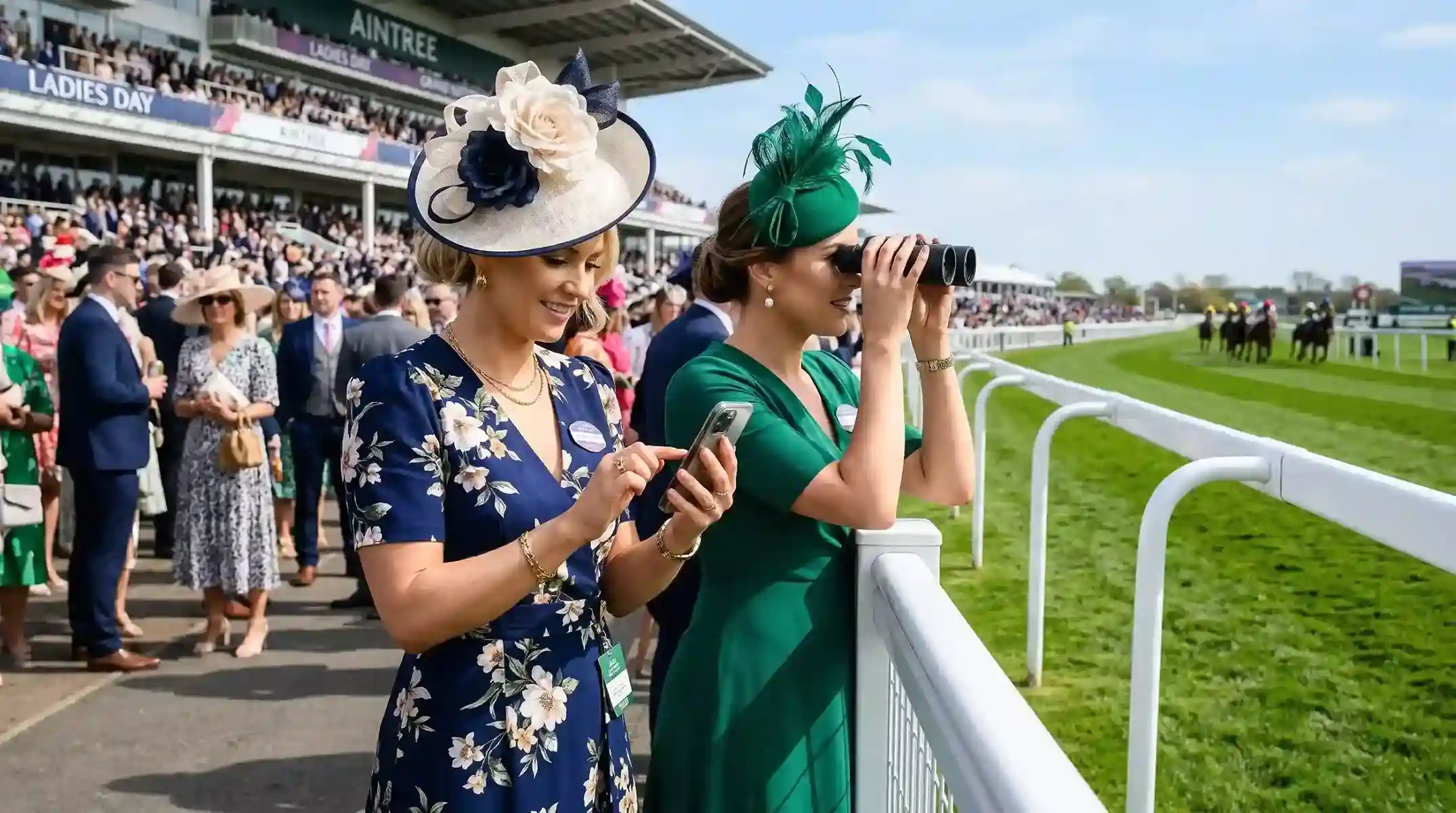
The Grand National has always been positioned as a race for everyone — the one day of the year when the entire country, not just the racing regulars, pays attention to what happens at Aintree. That positioning is broadly accurate, but the data reveals that “everyone” still skews male. According to an OLBG survey conducted ahead of the 2025 Grand National, 19% of men planned to place a bet on the race compared with 14% of women. The gap is narrower than in regular horse racing betting, but it exists, and it tells a story about how the Grand National’s audience is evolving — a changing field in every sense.
What makes the Grand National different is not just the size of female participation but the rate of change. Women are the fastest-growing segment of the once-a-year betting audience, and the cultural infrastructure around the race — particularly Ladies Day at Aintree — has helped shift perceptions of horse racing from a male-dominated pursuit to something closer to a shared national event.
Grand National Betting for Women — More on this topic at grand national betting odds.
Participation Gap: 19% Men vs 14% Women
The five-percentage-point gap between male and female participation in Grand National betting looks modest in isolation. In context, it is remarkable. Across the broader gambling market, the gender disparity is far wider: men are roughly twice as likely as women to bet on horse racing in any given month, according to Gambling Commission participation surveys. The Grand National compresses that gap because it draws in millions of people who do not normally bet at all — and the demographic profile of that occasional audience is far more balanced than the regular racing crowd.
The OLBG survey data breaks down further by age. The most active betting age group for the Grand National is 35 to 54, where 21% of adults planned to bet. Within that group, the gender gap narrows further, with women in their late thirties and forties representing a particularly strong growth segment. These are not traditional racing punters — they are people drawn in by the event, the office sweepstake, the social occasion, and the cultural visibility of the Grand National in a way that ordinary Saturday racing never achieves.
Stake sizes tell a parallel story. Women who bet on the Grand National tend to place smaller wagers than men, but this aligns with the broader pattern of Grand National betting rather than indicating timidity. The race is defined by modest stakes — the vast majority of bets are under £5 — and women’s betting behaviour fits squarely within that norm. The difference is not in how much women bet, but in the proportion who choose to bet at all. Closing the remaining five-point gap would represent a significant expansion of the Grand National’s betting audience, and bookmakers are increasingly targeting marketing campaigns accordingly.
The growth in female participation is also visible in account registrations. Bookmakers have reported rising proportions of female sign-ups in the weeks around the Grand National, driven partly by targeted promotions and partly by the normalisation of mobile betting. Betting from a phone in the living room while watching the race on ITV is a different experience from queuing at a betting shop counter — and the shift to mobile has removed a physical and cultural barrier that historically deterred many women from participating.
Ladies Day and Its Cultural Impact
Friday of the Aintree Festival is officially branded as Ladies Day, and it is one of the most attended single days in British sport. The three-day festival attracts around 150,000 visitors in total, with Ladies Day regularly drawing the largest individual crowd — up to 70,000 people, a significant proportion of whom are women. The event has become a cultural fixture in its own right, covered by fashion media as much as by racing press, and it serves as a gateway through which many women encounter horse racing for the first time.
The cultural impact of Ladies Day is complicated. Critics argue that the branding reduces women’s involvement in racing to a fashion event, sidelining their engagement with the sport itself. Supporters counter that any event drawing tens of thousands of women into a racing environment — where they watch competitive sport, interact with the betting market, and experience the atmosphere of a major festival — is a net positive for participation. The reality is probably both: Ladies Day simultaneously reinforces certain stereotypes and breaks down barriers to entry, depending on who is attending and why.
What is less debatable is the commercial effect. Ladies Day generates significant betting revenue — both on-course and through mobile accounts activated by attendees during the day. The racing on Friday’s card includes several high-quality handicap chases and hurdle races, and for many women attending Aintree for the first time on Ladies Day, the experience of placing a bet — even a small one — creates a connection with the sport that extends to the Grand National the following afternoon. The pipeline from Ladies Day attendance to Grand National betting is real, if difficult to quantify precisely.
Female Jockeys and Trainers in Grand National History
The most significant moment for women in Grand National history came in 2021, when Rachael Blackmore rode Minella Times to victory — becoming the first female jockey to win the race. The achievement was not merely symbolic. Blackmore was the leading jockey at that year’s Cheltenham Festival, had established herself as one of the best riders in the sport regardless of gender, and rode a tactically flawless Grand National on a horse perfectly suited to the race. Her victory reshaped public perceptions of who belongs at the sharp end of steeplechasing.
Before Blackmore, the Grand National had seen a slow but steady increase in female jockey participation. Katie Walsh recorded the best finish by a female jockey prior to 2021, placing third on Seabass in 2012. Bryony Frost became a regular National rider through the late 2010s. Each ride chipped away at the assumption — still surprisingly prevalent even in the 2020s — that the Grand National was too physically demanding for women jockeys. The race is undeniably brutal, but physical toughness is not gendered: what matters is technical skill, tactical intelligence, and the ability to manage a horse through four miles of intense jumping.
On the training side, women have made quieter but equally meaningful inroads. Venetia Williams trained Mon Mome to win at 100/1 in 2009 — one of the most famous Grand National results in living memory. Lucinda Russell trained One For Arthur to victory in 2017. Sue Smith prepared Auroras Encore, the 66/1 winner in 2013. These are not token representations; they are genuine competitive achievements at the highest level of the sport, produced by women operating in a training landscape that remains predominantly male.
Key Takeaway
The Grand National’s gender landscape is shifting in measurable ways. The participation gap in betting has narrowed to five percentage points — far tighter than in regular racing. Ladies Day brings tens of thousands of women into the Aintree atmosphere, and female jockeys and trainers have not just participated in the Grand National but won it at the highest level. The race remains a changing field in every sense: more diverse in its audience, its competitors, and its culture than at any point in its nearly two-century history. The data suggests that trend will continue.
See also Grand National Runners 2026.
