 Available in US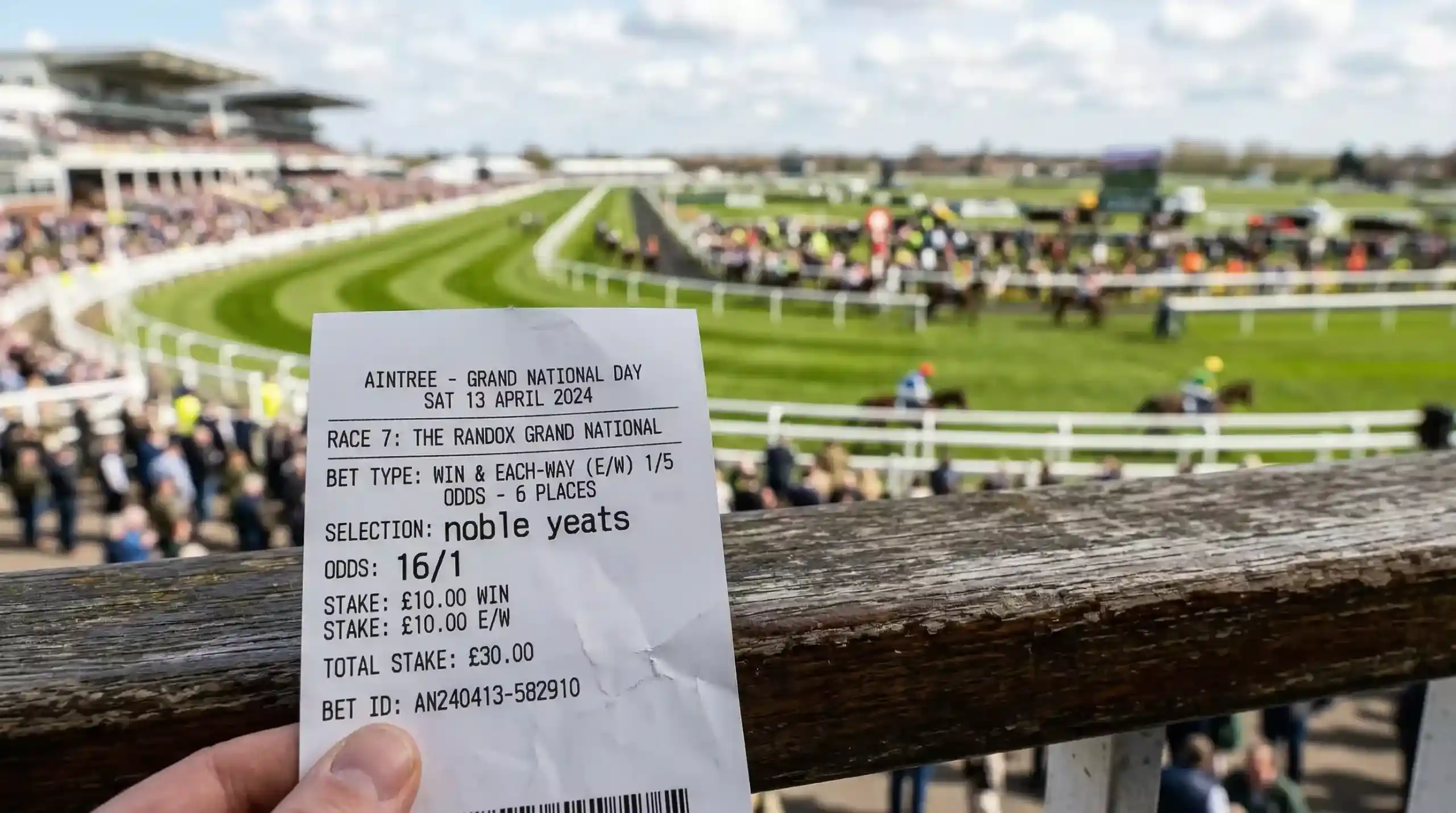
Best Odds Guaranteed is one of the most valuable concessions a bookmaker can offer on the Grand National, yet it remains one of the least understood. The concept is simple: if you take a price on your selected horse and the starting price on the day is higher, the bookmaker pays you at the better price automatically. Your price can only improve — it cannot get worse. In a race where odds shift constantly in the hours before the off, and where roughly 32% of all online bets are placed in the minutes before the start according to horseracing.guide, BOG removes the anxiety of locking in a price and then watching it drift in your favour after you have already committed.
For the Grand National specifically, BOG matters more than in most races. The market is volatile, the field is large, and late-breaking information — weather changes, jockey switches, going updates — can move prices by several points in the final hour. Understanding exactly how BOG works, where it applies, and where it does not is a practical edge that costs you nothing.
Best Odds Guaranteed on the Grand National Explained — More on this topic at grand national betting odds.
What Best Odds Guaranteed Means
The mechanics are straightforward. When you place a bet on a horse racing event at a bookmaker offering BOG, the firm records two prices for your bet: the price you took and the starting price determined at the track. If the SP is higher, your bet is settled at the SP. If the SP is lower, your bet is settled at the price you took. You get the better of the two, every time.
Take a concrete example. You back a Grand National runner at 16/1 on the morning of the race. Through the afternoon, money comes for the horse, and by the time the starter drops the flag the price has shortened to 12/1. Your bet is settled at 16/1 — the price you locked in. Now reverse the scenario: you take 16/1, but the horse drifts through the afternoon as other runners attract money. The SP is 20/1. With BOG, your bet is settled at 20/1. Without it, you are stuck at 16/1 and have effectively left four points of odds on the table.
The value of BOG is asymmetric — it protects you against downside (taking a price that gets worse) while giving you automatic access to any upside (a price that improves). In financial terms, it is a free option. No premium, no strings, just a guarantee that you will not be on the wrong side of a price movement after you have placed your bet. Over a large number of bets, this asymmetry adds measurable value. On the Grand National, where price movements of three, four, or five points are common on race day, a single BOG payout can be worth more than any free bet offer.
Most major licensed UK bookmakers offer BOG on British and Irish horse racing as standard. It is typically applied automatically — you do not need to opt in, tick a box, or enter a code. The bet is placed, and the system checks both prices at settlement. Mobile betting, which accounts for more than 70% of all online gambling activity in the UK according to Gambling Commission data, makes this process seamless: the same BOG terms apply whether you bet on your phone, tablet, or desktop.
When BOG Applies (and When It Doesn’t)
BOG typically activates from the morning of the race — usually from the time the bookmaker publishes its morning prices, or from a specified hour such as 8am or 9am. Bets placed after the morning prices are available and before the off qualify. This means that for Grand National day, any bet placed from Saturday morning onwards should be covered, provided the bookmaker is offering BOG on the race.
There are limits. Most bookmakers cap the maximum BOG payout — the extra amount you receive from the SP being higher than your price — at a fixed figure, often between £500 and £5,000 depending on the firm. For the vast majority of Grand National punters, this cap is irrelevant: a £10 bet at 20/1 produces a £200 win, well within any reasonable limit. But if you are placing a larger stake on a mid-priced runner, check the cap before assuming you are fully covered.
Some operators restrict BOG to win-only bets and do not extend it to the place part of an each-way bet. Others apply BOG to both parts. Since each-way is the dominant bet type on the Grand National, this distinction matters. If your bookmaker applies BOG only to the win element, and your horse finishes third at a starting price two points longer than the morning price, you receive the SP on the win part (which loses anyway) but the original price on the place part (which wins). Check the terms — the difference can be meaningful on a horse that places but does not win.
BOG does not apply on betting exchanges. Exchanges like Betfair do not set prices — they match bets between customers — so there is no bookmaker margin to subsidise a BOG concession. If you bet on the exchange, the price you take is the price you get. This is one of the rare situations where a traditional bookmaker has a structural advantage over an exchange: the possibility of a BOG payout can make a slightly shorter fixed-odds price more valuable than a longer exchange price, depending on how much you expect the SP to move.
BOG and Ante-Post: The Exception
The most important exclusion for Grand National bettors is ante-post. BOG almost never applies to bets placed before race day. If you back a horse at 25/1 in January and the starting price in April is 33/1, you will not receive the SP — you get 25/1, the price you locked in months ago. The rationale is that ante-post bets carry their own risk-reward trade-off: you get longer prices in exchange for accepting the risk that the horse might not run. BOG is designed for race-day betting, where the bookmaker is competing for your business on the morning of the event.
This creates a tactical question for Grand National bettors. If you have a strong ante-post opinion — a horse you believe is well handicapped and underpriced by the market — you can take the early price and accept that BOG will not apply. Alternatively, you can wait until race-day morning, take whatever price is available, and rely on BOG to protect you against any further movement. The right choice depends on how much the price has shortened between your initial assessment and race day. If a horse you identified at 33/1 in February is 16/1 on the morning of the race, the ante-post price was clearly superior despite the absence of BOG. If the price has barely moved, waiting for race-day BOG gives you protection at little cost.
Key Takeaway
Best Odds Guaranteed is a free concession that guarantees you the better of two prices — and on the Grand National, where race-day price movements are frequent and substantial, it can be worth several points of odds on a single bet. Verify that your bookmaker offers BOG on the Grand National, check whether it applies to both the win and place parts of an each-way bet, and remember that it does not cover ante-post wagers. On race-day morning, BOG turns every fixed-odds bet into a one-way trade: the price can only improve, never worsen. That is a structural advantage worth taking.
