
 Available in US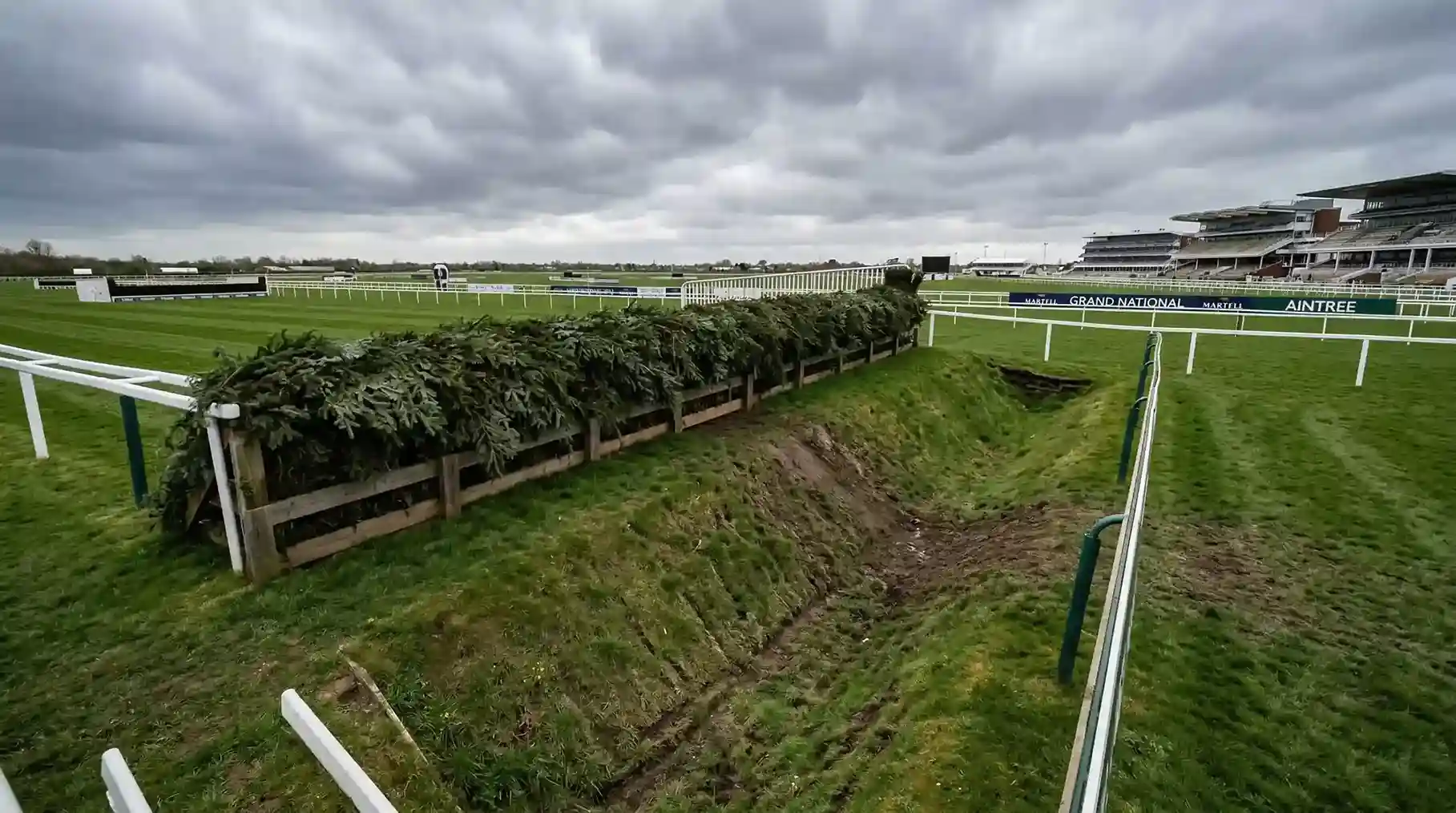
Every horse race is shaped by its course, but the Grand National is defined by it. Aintree’s National Course is four miles and two and a half furlongs of spruce-topped fences, open ditches, sharp turns, and one of the most demanding finishing stretches in British sport. No other track in the country asks this combination of questions: Can you jump big? Can you jump accurately? Can you do it thirty times over four miles without making a single catastrophic error? The answer, for most horses, is no — and that is what makes the Grand National the ultimate test of horse and jockey.
For bettors, the course is not scenery. It is the most important variable in the race. A horse with brilliant flat speed and a mediocre jumping technique is a worse bet here than a moderate galloper who pings every fence. Understanding the layout, the key obstacles, and the recent safety changes gives you an edge that most casual punters — many of them picking on name, colour, or instinct — simply do not have. Around 150,000 people attend the three-day Aintree Festival each year, but far fewer appreciate how the course itself filters the field.
Grand National Course and Fences — More on this topic at grand national betting odds.
Course Layout: Two Laps, 30 Jumps, 4+ Miles
The Grand National course is a roughly triangular loop that runners complete twice. There are 16 unique fences on the circuit, and because horses jump most of them on both laps, the total number of jumping efforts comes to 30. The two fences closest to the stands — the first and the sixteenth, known as The Chair and the Water Jump — are bypassed on the second circuit, which is why the total is 30 rather than 32.
The distance is the longest of any major race in Britain. At four miles, two furlongs, and 74 yards, it is nearly twice the length of a standard three-mile chase and roughly a mile longer than the Cheltenham Gold Cup course. That extra distance is not just a stamina test — it changes the tactical dynamics of the race entirely. Horses that are held up early, conserving energy through the first circuit, have a structural advantage over front-runners who burn through their reserves tackling the big fences at speed. Most modern Grand National winners have been ridden patiently for at least the first mile and a half.
The terrain is not flat. The course undulates gently, with a notable drop behind Becher’s Brook and a long, energy-sapping uphill run from the last fence to the winning post. That final stretch — known as the Elbow because of a sharp left-hand kink — is roughly 500 yards of rising ground where races are won and lost. Horses that look full of running at the second-last fence can empty completely on the run-in, and frontrunners who have led for the final mile frequently get caught in the closing strides.
The Famous Fences: Becher’s, Canal Turn, The Chair
Becher’s Brook, jumped as the sixth and the twenty-second fence, is the Grand National’s most infamous obstacle. The fence itself is not especially tall — roughly four feet eight inches — but the landing side drops away sharply, creating an effect where horses seem to fall off a cliff as they clear the spruce. The drop has been reduced in successive modifications, most recently in 2013, but it remains the single biggest test of a horse’s jumping technique. Horses that jump steeply — getting high over the fence and landing with their weight forward — cope better than flat-jumping types who meet the drop on their forehand. Becher’s has produced more fallers over the years than any other fence on the course, and every serious form analysis of a Grand National runner includes a note on how the horse handles a drop landing.
The Canal Turn, fence seven and twenty-three, is an entirely different challenge. The fence is followed immediately by a near-ninety-degree left-hand turn, and the field must negotiate both in rapid succession. Horses on the inside have the shortest route but risk being squeezed against the rail. Those on the outside jump straighter but lose ground through the turn. Jockeys who know Aintree — and there is a significant advantage for experienced National riders — position their horses to the inner on approach, knowing that the tight turn rewards precision over raw speed.
The Chair, fence fifteen, is the tallest obstacle on the course at five feet two inches, with a six-foot open ditch on the take-off side. It is jumped only once, on the first circuit, and it stands directly in front of the grandstands. The combination of height, ditch width, and atmosphere makes it one of the most daunting individual jumps in steeplechasing. Horses that clear The Chair confidently tend to grow in confidence for the remainder of the race. Those that make a hash of it — pecking on landing or clipping the top — often lose momentum they never recover.
Beyond the marquee fences, several other obstacles deserve attention. Valentine’s Brook (fence nine and twenty-five) has a brook on the landing side that catches careless jumpers. The open ditches at fences three and eleven require precise take-off timing. And the first two fences, jumped at pace in the early rush when the field is at its most compact, produce a disproportionate number of fallers simply because of the congestion and adrenaline at the start of the race.
Safety Changes Since 2024 and Their Impact
The most significant recent change to the Grand National was the reduction of the maximum field from 40 to 34 runners in 2024. This was the first such reduction in roughly 40 years and was driven by safety data showing a clear relationship between field size and the incidence of falls. Fewer horses on the course means less congestion at fences, more room for jockeys to pick their line, and fewer instances of horses being brought down by fallers ahead of them.
The change has had a measurable effect on the race’s character. The 2024 running, the first under the new limit, was notably less chaotic than many recent renewals. The smaller field reduced the pile-up risk at the early fences and at Becher’s, where a mass of 40 runners used to create a dangerous crush on the first circuit. For bettors, the practical consequence is that form is slightly more reliable than it was under the old format. A good horse is less likely to be eliminated by bad luck at a crowded fence, which marginally increases the chance of form holding true.
Fence modifications have continued alongside the field-size change. The drops at Becher’s and other key fences have been softened over successive years, and the spruce tops are now designed to be more forgiving on horses that brush through the top rather than clearing them cleanly. These modifications have not fundamentally altered the character of the race — it remains the most demanding steeplechase in the world — but they have incrementally reduced the rate of serious incidents, which in turn has made the race marginally more predictable from a betting perspective.
How Course Knowledge Helps Your Bet
Course knowledge translates into two practical edges. The first is horse selection: look for runners with proven jumping ability over demanding fences, experience over distances beyond three miles, and — ideally — previous form at Aintree itself. Horses that have completed the Grand National course before, even without winning, hold a significant advantage over debutants. They know the drops, the turns, and the relentless length of the race. Second-season National runners have a strong record precisely because they have encountered these obstacles before and survived.
The second edge is jockey selection. A horse partnered by a jockey who has ridden the National course multiple times — riders like Rachael Blackmore, Sam Twiston-Davies, or Davy Russell in recent years — benefits from tactical awareness that cannot be replicated in training. Knowing when to commit at Canal Turn, where to sit through the first circuit, and how much horse to keep in reserve for the Elbow run-in is the difference between a calculated ride and a hopeful one. When two horses look equal on form and weight, the jockey’s Aintree experience should be the tiebreaker.
See also Cheltenham Festival Form and Grand National Odds Link.
