
 Available in US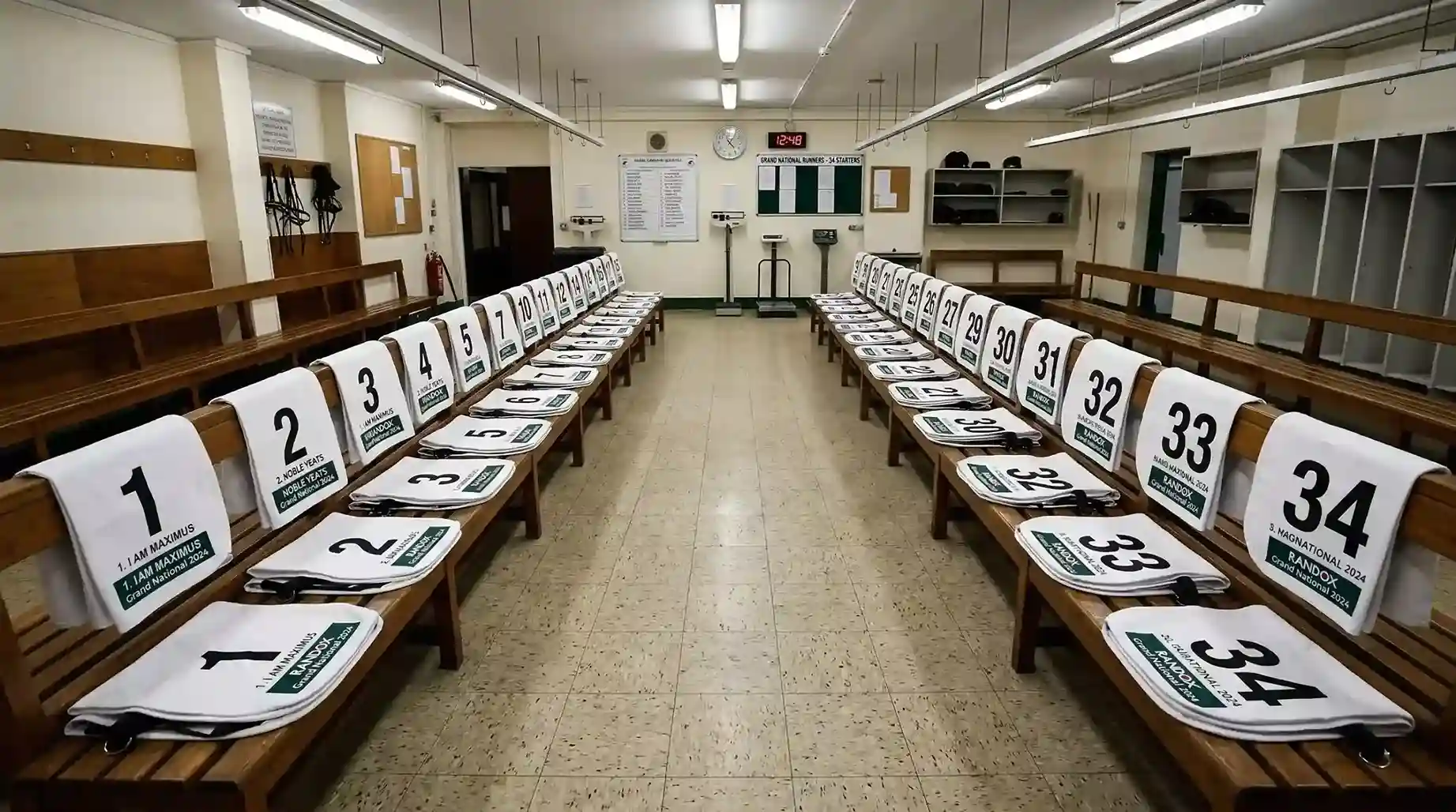
For roughly four decades, the Grand National was a race for 40 horses. In 2024, the Jockey Club reduced that maximum to 34 — the most significant structural change to the race in a generation. The decision was not cosmetic or commercial. It was driven by safety data, by veterinary evidence, and by years of incremental modifications to the Aintree course that ultimately pointed to one conclusion: fewer runners means fewer falls, fewer injuries, and fewer fatalities. Safety reshaped the race, and the betting market — whether it realised it or not — was reshaped along with it.
The reduction was controversial precisely because the Grand National’s identity is built on its scale: the enormous field, the chaos of 40 horses thundering into the first fence, the attrition of four miles and thirty jumps. Removing six runners from that equation changed the character of the race in subtle but measurable ways. Understanding those changes is essential for anyone betting on the modern Grand National.
Grand National Field Size Change — More on this topic at grand national betting odds.
The Safety Rationale: Evidence and Decision
The Jockey Club’s decision was rooted in data collected over decades. Analysis of fall rates across multiple Grand Nationals showed a clear correlation between field size and the number of fallers, unseated riders, and horses brought down. Dickon White, then Regional Director of the Jockey Club, stated the case plainly: there is a direct link between the number of runners and the risk of falling, unseating, or being brought down. The relationship is not linear — it is not that each additional runner adds exactly the same amount of risk — but the overall pattern is unambiguous. Larger fields produce more incidents.
The most dangerous moments in a Grand National occur at the early fences, where the field is at its most compact and horses have the least room to manoeuvre. At 40 runners, the first two fences became a lottery of close-quarters jumping where even a well-schooled horse could be brought down by a faller beside it. At 34, the density is reduced, the gaps between runners are wider, and jockeys have more options to steer clear of trouble. The improvement is particularly notable at Becher’s Brook on the first circuit, where the compressed field of 40 used to create genuine crush conditions on the landing side.
The fence modifications of previous years — levelling the drops at Becher’s, softening the spruce, adjusting take-off and landing areas — had already reduced individual fence risk. But those changes could not address the systemic risk created by the sheer number of horses on the course simultaneously. The field reduction was the logical next step: having made each individual obstacle safer, the Jockey Club turned its attention to the competitive environment as a whole.
The decision also reflected external pressure. Animal welfare campaigns had targeted the Grand National for years, with high-profile fatalities generating negative media coverage and protests. While the Jockey Club’s announcement framed the reduction as evidence-based rather than political, the practical effect was to defuse some of the welfare criticism by demonstrating a willingness to make meaningful changes to the race’s format.
Betting Implications: Fewer Runners, Tighter Market
The reduction from 40 to 34 runners has measurable consequences for the betting market. The most obvious is that the over-round — the bookmaker’s built-in margin — is potentially lower, because there are fewer runners on which to distribute margin. A 34-runner market is structurally tighter than a 40-runner market, which should produce slightly better odds for bettors, all else being equal.
More importantly, the smaller field changes the competitive dynamics of the race itself. With six fewer runners, the congestion at fences is reduced, which means that good horses are less likely to be eliminated by bad luck. In a 40-runner Grand National, a genuine contender could be brought down at the first fence by a faller beside it — an outcome that had nothing to do with the horse’s ability and everything to do with the crowded conditions. At 34, that risk is diminished. The probability of form holding true — of the best horses lasting long enough to contest the finish — has increased.
This shift makes the Grand National slightly more formful and slightly less random, which in turn affects how bettors should approach the race. The historical argument for backing longshots — based on the premise that chaos was so prevalent it equalised the field — is weaker at 34 runners than at 40. Favourites and well-fancied runners have a marginally better chance of surviving the early obstacles and completing the race, which supports a strategy tilted slightly more toward form-based selections and slightly less toward pure outsider punts.
The Aintree Festival’s overall attendance has remained resilient despite the field reduction. Around 150,000 people attended the three-day festival in both 2024 and 2025, suggesting that the smaller field has not diminished the event’s appeal to the racegoing public. The spectacle of 34 horses jumping Aintree’s fences over four miles is still extraordinary — it is just marginally less chaotic than it used to be.
Results Since 2024: Was It the Right Call?
The 2024 Grand National — the first run under the 34-runner limit — was widely regarded as a safer and more competitive race than many of its recent predecessors. I Am Maximus won convincingly at 11/2, the shortest-priced winner in several years, which some interpreted as evidence that the smaller field favours the classier horse. The completion rate was healthy: a higher proportion of runners made it round than in several recent 40-runner renewals. There were no equine fatalities.
One race is not a definitive dataset, but the early evidence supports the Jockey Club’s rationale. The 2024 result was not a fluke; it was consistent with what the safety data predicted. A cleaner race, a higher completion rate, and a result that rewarded the best horse in the field rather than the luckiest survivor. If the pattern holds over subsequent years, the 34-runner Grand National may prove to be a better race for form analysis while retaining the drama and spectacle that makes it unique.
The counterargument — that the Grand National’s appeal lies partly in its unpredictability, and that a more formful race is a less exciting one — deserves acknowledgement. There is a reason the Grand National generates £250 million in bets: people love the chaos, the longshot winners, the stories that defy logic. If the 34-runner format consistently produces shorter-priced winners, the casual betting audience — the once-a-year punters who bet on a name or a hunch — may find the race less compelling. The tension between safety and spectacle is real, and the field reduction sits at the centre of it.
Key Takeaway
The reduction from 40 to 34 runners was the most significant change to the Grand National in decades, driven by safety evidence and executed despite the race’s identity as the ultimate large-field spectacle. For bettors, the smaller field produces a slightly more formful, slightly less chaotic race — which means a modest shift toward form-based selection and a modest reduction in the probability of extreme longshot winners. Attendance and betting volume have held up, and early results suggest the change has improved safety without destroying the race’s essential character. Safety reshaped the race, and the smart bettor’s approach should reshape with it.
